Publish a privacy policy that actually matches your site
App Store review is blocking your submission. Or Google Ads flagged the account. Or a client’s procurement form asks for a link and you realise the footer says “Privacy Policy” but points nowhere.
Whatever brought you here, the fix is the same and it should not take a week.
Describe your website or app, the data you collect and the tools you use. Indigo AI writes a complete privacy policy covering data collection, lawful basis, cookies, third-party processors, retention and user rights — in your language, for your jurisdiction.
Generate My Privacy Policy Free →
 Written in about 60 seconds ·
  GDPR, CCPA and local law aware ·
  PDF download ·
  Fully editable
Why a copied privacy policy is worse than none
A privacy policy is a statement of fact about your business. It says: here is what we collect, why we collect it, who we share it with, and what you can do about it.
Which is why copying one from another website is a genuinely bad idea, not merely a lazy one. A borrowed policy describes someone else’s data practices. If it says you do not use third-party analytics and you run Google Analytics, your published policy is now inaccurate — and an inaccurate policy is a documented misstatement about how you handle personal data, which is a worse position than an incomplete one.
There is also a practical layer. Several platforms will not let you operate without one:
- Apple App Store and Google Play require a privacy policy URL before an app is published
- Google AdSense and Google Ads require one on any site running their tags
- Stripe, PayPal and most payment processors expect one during onboarding
- Meta, TikTok and LinkedIn ad platforms require a policy for pixel usage
- B2B procurement and vendor reviews routinely request the link
And separately from platform rules, data protection law applies to businesses of every size. The GDPR in the EU and UK, the CCPA and CPRA in California, the DPDP Act in India, LGPD in Brazil and PIPEDA in Canada all impose transparency obligations that scale down to very small operations.
Why use an AI privacy policy generator
It describes your site, not a generic one. Most free generators output the same document with your company name swapped in. Describing your actual stack — the analytics you run, the payment processor you use, whether you have accounts, whether you email customers — produces a policy that matches reality.
It handles multiple frameworks together. If you have EU visitors and California visitors and Indian customers, you need a policy that addresses all three sets of rights without turning into three separate documents. Say so in your prompt.
It covers the sections people forget. Retention periods, international transfers, children’s data, automated decision-making, the identity of your data controller, and how someone actually exercises their rights. These are the sections that reviewers check.
It is easy to update. Privacy policies go stale. You add a chat widget, switch email providers, start using a new analytics tool. Regenerating takes a minute rather than a meeting.
Free to start. New accounts include credits. A medium-length policy uses 2 credits; a longer one covering multiple jurisdictions uses 3. No subscription — credit packages start at $5 for 50 credits.
How it works
Step 1 — Choose how you want to start
Type the details, dictate them, or upload your existing policy as a PDF or image so the AI can build an updated version from it. Uploaded files are deleted automatically after processing.
Step 2 — Select Business & Corporate, then your jurisdiction
Pick the category, then your country, state and language.
Step 3 — Describe your site or app and what it collects
Be specific. The more you describe, the more accurate the policy:
Privacy policy for a SaaS project management web app. We collect name, email, company name and billing address at signup. We use Google Analytics 4, Stripe for payments, Postmark for transactional email and Intercom for support chat. Data hosted on AWS in Ireland. Users are in the EU, UK and India. Accounts can be deleted on request. Cookies used for authentication and analytics.
Step 4 — Review and adjust
Your policy arrives in about a minute. Correct anything that does not describe your business accurately — this is the step that matters most. Add your contact address, your data protection officer if you have one, and your effective date.
Step 5 — Publish it
Download the PDF or copy the text into your site. Link it in your footer, at signup, at checkout, and in your app store listing. Update it whenever your tooling changes.
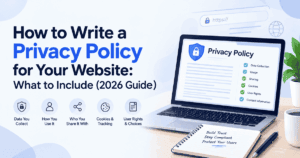
What your privacy policy includes
- Identity of the controller — who you are and how to contact you
- Data collected — separated into information the user provides, information collected automatically, and information from third parties
- Purpose of processing — why each category is collected
- Lawful basis — consent, contract, legitimate interest or legal obligation, where the framework requires it
- Cookies and tracking — types used, purposes, and how to manage them
- Third-party processors — analytics, payments, hosting, email and support tools, named
- International data transfers — where data goes and the safeguards applied
- Data retention — how long each category is kept and on what basis
- Security measures — the technical and organisational steps you take
- User rights — access, correction, deletion, portability, objection and withdrawal of consent
- How to exercise those rights — the actual mechanism, not just a statement that rights exist
- Children’s data — age thresholds and treatment
- Automated decision-making and profiling — where applicable
- Complaints — the supervisory authority a user can escalate to
- Changes to the policy — how updates are communicated
- Effective date and last-updated date
Example: what a generated policy looks like
Prompt entered:
Privacy policy for a Shopify clothing store shipping to the US and EU. We collect name, email, shipping address and phone. Payments via Shopify Payments and PayPal. Klaviyo for marketing email, Meta Pixel and Google Analytics for advertising. We store order history indefinitely for accounting. Marketing emails are opt-in with unsubscribe.
What Indigo AI returns:
A privacy policy identifying the store as controller with contact details left as fields to complete. Data collected is separated into checkout information, account information and automatically collected browsing data. Purposes are mapped individually — order fulfilment, payment processing, marketing communication and advertising measurement — each with a stated lawful basis for EU visitors. Third-party processors are named with links to their own policies. The cookies section separates strictly necessary, analytics and advertising cookies, and explains consent management for EU visitors. Retention distinguishes order records kept for accounting purposes from marketing data retained until unsubscribe. A rights section sets out access, deletion, portability and objection, with a described request process. CCPA-specific disclosures cover the sale and sharing of personal information for advertising purposes and the opt-out mechanism. The policy closes with complaints routes and an effective date.
Around 1,900 words. Generated in about a minute. Editable throughout.
Who uses this
Website owners and bloggers who need a policy for AdSense approval or affiliate programme compliance.
App developers facing an App Store or Play Store submission that requires a privacy policy URL.
Ecommerce stores collecting shipping and payment data across multiple regions.
SaaS founders who need a policy that survives a customer’s security questionnaire.
Agencies publishing client sites and needing a defensible policy for each one rather than a copy of the same file.
Freelancers running a portfolio site with a contact form — which, yes, is personal data collection.
Mistakes worth avoiding
Naming tools you do not use, or omitting ones you do. The most common problem with generated policies. Read the third-party section carefully and correct it.
Publishing it and never updating it. A policy dated three years ago, describing an email provider you left, is evidence that you are not managing this area.
Saying “we do not share your data” while running an advertising pixel. Advertising pixels typically involve sharing data with the platform. Under CCPA and CPRA this may count as sharing or selling and needs disclosure.
No stated retention period. “We keep data as long as necessary” is not a retention policy. Give periods by category.
Burying it. The policy needs to be reachable from your footer, your signup form and your checkout, not from a page only you can find.
Confusing it with terms of service. Different documents with different jobs. A privacy policy explains data handling; terms of service set the rules of using your product. Most sites need both.
Frequently Asked Questions
Is the AI privacy policy generator free?
You can start free with the credits included on new accounts. A medium-length policy uses 2 credits and a longer multi-jurisdiction one uses 3. There is no subscription — credit packages start at $5 for 50 credits.
Does the policy cover GDPR and CCPA?
Yes, when you say so. Name the regions your users are in and the applicable frameworks are addressed, including lawful basis and rights sections for the GDPR and disclosure and opt-out sections for CCPA and CPRA. We recommend a professional review before publishing if you handle sensitive data at scale.
Do I need a privacy policy for a small website?
If you collect any personal data — including through a contact form, newsletter signup or analytics — then in most jurisdictions, yes. Many platforms also require one regardless of your size.
Can I use this for a mobile app?
Yes. Describe your app, the permissions it requests and the SDKs it includes. Both major app stores require a policy URL before publication.
How often should I update my privacy policy?
Whenever your data practices change — a new analytics tool, a new payment processor, a new region — and as a general review at least once a year.
Can I get it as text for my website rather than a PDF?
The document downloads as a PDF and the content is fully editable before download, so you can copy the text into your CMS.
Does it include a cookie policy?
Cookie disclosure is included as a section within the policy. If you need a standalone cookie policy, request it in your prompt.
Is this a substitute for legal advice?
No. IndigoEDocs produces AI-assisted drafts. If you process sensitive personal data, operate at scale, or work in a regulated sector such as health or finance, have your policy reviewed by a qualified data protection professional.
Do I need terms of service as well?
Usually yes. A privacy policy covers data handling; terms of service govern use of your product. They are separate documents and most websites publish both.
Related documents
- Privacy Policy Generator — manual form builder version
- AI Partnership Agreement Generator — for the business behind the website
- AI NDA Generator — protect information shared with developers and vendors
- Independent Contractor Agreement — for the freelancers building your site
- Payment Invoice — billing documentation
- AI Document Analyzer — review a data processing agreement before you sign it

Types of Power of Attorney: Which One Do You Need?

Loan Agreement vs Promissory Note: Which One Do You Need?
Privacy Policy for Website: What to Include

Partnership Agreement Clauses You Need