
- What Is an Affidavit of Lost Document and Why Courts Require It
- 6 Common Situations That Require an Affidavit of Lost Document
- What to Include in an Affidavit of Lost Document
- Step-by-Step Guide: How to Generate an Affidavit of Lost Document with IndigoEDocs
- Does an Affidavit of Lost Document Need to Be Notarized?
- Tips for a Smooth Process
- Frequently Asked Questions
- The Bottom Line
You’ve torn the house apart looking for it.” You’ve gone through every drawer, every folder, that one shoebox of “important stuff” you promised you’d organize someday. Vanished. The passport, the deed to the house, the title to the car – it’s gone, whatever it is. Before you panic, here’s the good news: there’s an actual legal process for this exact situation. It’s called an affidavit of lost document, and it’s how you officially replace, prove, or move forward with whatever you’ve misplaced.
Let me walk you through what it is, when you need one, and how to get a legally sound version in about 60 seconds.
What Is an Affidavit of Lost Document and Why Courts Require It
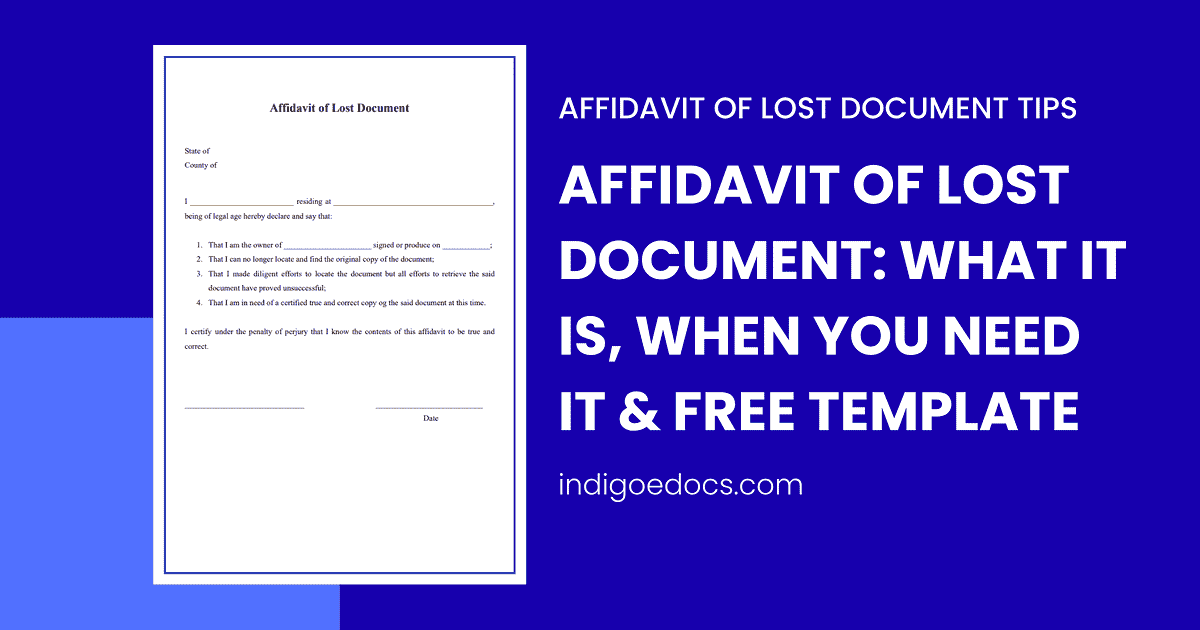
An affidavit of lost document is a sworn legal statement in which you swear that a particular document has been lost, destroyed or stolen. You (the \”affiant\”) sign it, often having it notarized, and file it with whatever institution needs proof — a government office, bank, insurance company, court, or registrar.
Think of it like this: when an original document goes missing, institutions can’t just take your word for it. Too much risk of fraud, duplicate claims, or someone trying to scam the system. The affidavit creates a formal, legal record that says: “I, [your name], swear that this document is genuinely lost, that I haven’t transferred it to anyone, and that I’m requesting a replacement or alternative action.”
Why does this matter? A few reasons:
- Legal protection — You’re not held liable if someone else finds and misuses the original
- Institutional compliance — Government offices and banks legally require it before issuing duplicates
- Fraud prevention — Creates a paper trail showing you reported the loss in good faith
- Court admissibility — If the matter ever ends up in court, you have documented evidence
Without an affidavit of lost document, most institutions simply won’t process your request. It’s not optional in most situations — it’s the gatekeeper.
6 Common Situations That Require an Affidavit of Lost Document
Here are the most frequent scenarios where you’ll need one. If any of these sound familiar, you’re in the right place:
1. Lost Passport
Most likely the most common case. Most authorities will need a sworn statement detailing when and where the original was lost and stating that it is not accessible to anyone else, before a replacement passport can be issued. The police report and the affidavit are usually attached to your substitute application.
2. Lost Property Deed
This one is serious. Ownership of real estate is shown by a deed. If it is not, you will need to obtain an affidavit of lost document before the registrar’s office will issue a certified duplicate. If you don’t, you could find it hard to sell, mortgage or transfer the property.
3. Lost Vehicle Title
No vehicle title means you can’t legally sell or transfer the vehicle. The DMV (or equivalent in your country) requires an affidavit declaring the loss before issuing a duplicate title. Some jurisdictions also require a waiting period or additional verification.
4. Lost Insurance Policy Documents
Filing a claim on a missing insurance policy? You will need an affidavit stating that the policy is lost and that you are the rightful policyholder. This is used by insurance companies to avoid duplicate claims and to verify your benefits entitlement.
5. Lost Academic Certificates or Degrees
Universities and educational boards require a sworn affidavit before issuing duplicate degrees, marksheets, or transcripts. Often paired with a police complaint and newspaper notice (especially in countries like India), the affidavit becomes part of your official replacement application.
6. Lost Bank Documents (Cheque Books, Fixed Deposit Receipts, Bonds)
Banks won’t reissue or honor a lost fixed deposit receipt, bond, or share certificate without an affidavit of lost document. It indemnifies the bank against potential fraud claims if the original ever resurfaces.
Bonus Cases
- Lost stock certificates and bonds
- Lost will or testamentary documents
- Lost business licenses and registration certificates
- Lost professional licenses (medical, legal, CPA)
What to Include in an Affidavit of Lost Document
A properly drafted affidavit isn’t just a casual “I lost my stuff” note. It’s a legal document with specific required elements. Here’s exactly what needs to be in it:
1. Affiant Information
Your full legal name, address, date of birth, and identification details (passport number, driver’s license, etc.). This establishes who is making the sworn statement.
2. Detailed Description of the Lost Document
Be specific. Include:
- Type of document (passport, deed, title, etc.)
- Document number or identifying reference
- Date of issue
- Issuing authority
- Any other unique identifiers
The more detail, the stronger the affidavit. “I lost my passport” is weak. “I lost my Indian passport number Z1234567, issued by RPO Mumbai on 15 January 2022” is enforceable.
3. Circumstances of the Loss
When did you notice the document was missing? Where were you? What did you do to find it? Did you file a police report? Institutions look for a coherent timeline. Be honest and factual.
4. Declaration of Good Faith
A statement confirming:
- You haven’t sold, pledged, or transferred the document to anyone
- You haven’t used the document fraudulently
- If the original is found, you’ll return it to the issuing authority
- All statements in the affidavit are true to the best of your knowledge
5. Indemnity Clause
This protects the institution issuing a duplicate. You essentially agree that if the loss declaration turns out to be false or fraudulent, you’ll cover any damages or legal costs.
6. Signature and Notarization
You sign the affidavit in the presence of a notary public (or magistrate, depending on jurisdiction). The notary verifies your identity and witnesses your signature, giving the document legal weight.
7. Supporting Attachments
Usually attached to the affidavit:
- Copy of your ID proof
- Police report or FIR (if applicable)
- Newspaper notice (required for certain documents in some jurisdictions)
- Any other proof of original ownership
Step-by-Step Guide: How to Generate an Affidavit of Lost Document with IndigoEDocs
Here’s the fast track — no Microsoft Word headaches, no template hunting, no missing clauses.
Step 1: Visit the Affidavit Generator
Go to the IndigoEDocs affidavit of lost document page. You’ll see a clean form ready to capture your details.
Step 2: Fill in Your Information
The AI walks you through targeted questions:
- Your personal details (name, address, ID)
- Document specifics (type, number, issuing authority)
- Circumstances of the loss
- Jurisdiction (so the language matches your local legal standards)
It takes about 2–3 minutes of typing.
Step 3: Review the Generated Document
The system creates a complete, legally precise affidavit instantly. Review it carefully — make sure dates, names, and document numbers are accurate. Edit anything that needs adjustment.
Step 4: Download in Your Preferred Format
Export as PDF or Word document. Both are accepted by most institutions.
Step 5: Get It Notarized
Print the affidavit, sign it in front of a notary public (or magistrate, depending on your jurisdiction), and have them stamp and sign it. Most notaries charge between $5 and $25.
Step 6: Submit With Supporting Documents
Bundle the notarized affidavit with your ID proof, police report (if needed), and any other required attachments. Submit to the relevant authority — passport office, DMV, bank, university, etc.
That’s it. From “I lost my document” panic to “submitted and processed” in roughly an hour, including the notary visit.
Need a related document like an affidavit of ownership? IndigoEDocs has those covered too — useful when you need to prove ownership of property, vehicles, or assets without the original title.
Does an Affidavit of Lost Document Need to Be Notarized?
Short answer: almost always, yes.
An affidavit, by definition, is a sworn statement. For the swearing part to have legal weight, you need an authorized official to witness it. Depending on your country and the institution requesting it, that’s typically:
- United States — Notary public
- United Kingdom — Solicitor or commissioner for oaths
- India — Notary public or magistrate, often on stamp paper of the required value
- Canada — Commissioner of oaths or notary public
- Australia — Justice of the Peace or solicitor
A few exceptions exist where institutions accept self-declared affidavits without notarization, but they’re rare. When in doubt, get it notarized. It’s cheap, takes 10 minutes, and removes any chance of your application being rejected.
Tips for a Smooth Process
A few practical things I’ve seen trip people up:
- File a police report first if the document was stolen or lost in a public place. Many institutions require the FIR/police report number on the affidavit itself.
- Publish a newspaper notice if your jurisdiction requires it (common in India for academic certificates and property deeds). This creates public record of the loss.
- Keep copies of everything — the affidavit, supporting documents, submission receipts. You’ll thank yourself later.
- Match the language to the institution — A passport office wants slightly different details than a bank. The IndigoEDocs generator handles this automatically based on your inputs.
- Don’t delay — The longer you wait, the more questions arise about why you didn’t report the loss sooner.
Frequently Asked Questions
A: The affidavit itself does not expire but most institutions will accept only if it’s recent, i.e. within 30 to 90 days of the date of issuance. You may need to file a new affidavit if it takes you too long to replace.
A: Well yeah but it’s dangerous. Your affidavit can be rejected for missing clauses, incorrect language, or a mismatch of jurisdictions. Tools like IndigoEDocs ensure that your document is legally accurate and accepted by institutions.
A: A police report (FIR) documents that you reported the loss to law enforcement — used mainly when theft or public loss is involved. An affidavit of lost document is a sworn personal declaration of the loss, used for legal and institutional purposes. You often need both.
A: In most cases, no. Government offices, banks, and universities require sworn proof of loss before issuing duplicates. An affidavit of lost documents is the standard legal mechanism for this.
A. The creation of the document itself, using IndigoEDocs, is free. The only cost is for notarization (usually $5–$25 in most jurisdictions) and, where applicable, stamp paper or newspaper notice fees. Cost is usually under $50 versus hundreds for a lawyer drafted affidavit.
The Bottom Line
Lost important document? That’s stressful. But the legal fix is easy, quick and cheap. The recognized customary method of announcing the loss and proceeding with replacements or alternatives thereof is by an affidavit of lost document.
You don’t require a lawyer. No paperwork hours to finish. You will need to have a properly prepared affidavit, a notary stamp and the documents your institution requires.
Generate your free Affidavit of Lost Document with Indigo e-Docs — it takes about 60 seconds, requires no account, and gives you a legally precise document ready to print, notarize, and submit. No lawyer fees. No confusion. Just done.