- What is an AI Document Analyzer (and How Does it Really Work)?
- 5 Types of Business Documents You Should Always Run Through an AI Document Analyzer
- Step-by-Step: How to Use Indigo e-Docs’ AI Document Analyzer
- What the AI is Searching For: Clauses, Red Flags & Duties
- Free AI Document Analysis vs. Paying a Lawyer: Real Cost Comparison
- Why Free AI Doc Analysis Is Becoming the New Standard
- When AI Document Analysis Isn’t Enough
- Frequently Asked Questions
- The Bottom Line
An AI document analyzer can read a 40-page contract in under 30 seconds, flag the risky clauses, and tell you exactly what you’re agreeing to — for free. No lawyer billable hours. No squinting at fine print at 11 p.m. before a deadline.
If that sounds too good to be true, bear with me. Because the technology has finally caught up with the promise – and millions of small business owners, freelancers and startup founders are already using AI doc analysis to make smarter decisions before they sign anything.
Here’s everything you need to know about using a free AI document analyzer — what it does, how it works, and how to actually use one to protect yourself.
What is an AI Document Analyzer (and How Does it Really Work)?
An AI document analyzer is a tool that uses natural language processing (NLP) and machine learning to read legal and business documents. Instead of you manually scanning each line, the AI pulls out the good stuff – key clauses, obligations, deadlines, payment terms, termination conditions, and anything that looks out of the ordinary or risky.
Think of it as a paralegal reviewing every document before you sign, only in seconds rather than days.
Here’s what’s happening under the hood:
- You upload a document (PDF, Word file, image, or scanned doc)
- The AI extracts the text using OCR if needed
- NLP models parse the language to understand context and meaning
- The system categorizes clauses — payment terms, IP ownership, liability, termination, etc.
- It flags risks and unusual terms based on patterns trained from millions of legal documents
- You get a clear summary with actionable insights
The best part? Modern AI document analyzers like the Indigo e-Docs AI document analyzer don’t just summarize — they actually explain what each clause means in plain English. That’s huge if you’re not a lawyer.
5 Types of Business Documents You Should Always Run Through an AI Document Analyzer
Not every document needs a deep legal review. But these five? Always analyze them before you sign:
1. Service Agreements & Contracts
Whatever side you’re on—hiring a freelancer or signing on as one—service agreements have a ton of devils in the details. Payment terms, revision limits, IP ownership and termination clauses can make-or-break the deal.
2. NDAs (Non-Disclosure Agreements)
But NDAs often have language that is too broad about what constitutes “confidential information,” or unfair non-compete clauses disguised as confidentiality terms. An AI document analyzer detects these in real time.
3. Independent Contractor Agreements
This is a big one. If you’re hiring contractors or working as one, the independent contractor agreement defines everything — scope, payment, ownership of work, liability. Get it wrong and you’re looking at tax issues or IP disputes.
4. Vendor & Supplier Contracts
The big thing here is auto-renewal clauses. So are unilateral rights to raise prices and limits on liabilities. AI doc analysis finds this in seconds.
5. Lease Agreements & Terms of Service
Whether it’s a commercial lease, a SaaS agreement or a partnership agreement, anything that’s multi-page legalese stands to gain a lot from AI business documents analysis. You wouldn’t believe what gets buried on page 17.
Step-by-Step: How to Use Indigo e-Docs’ AI Document Analyzer
Using a free AI document analyzer is genuinely simple. Here’s the exact workflow:
Step 1: Go to the AI Document Analyzer
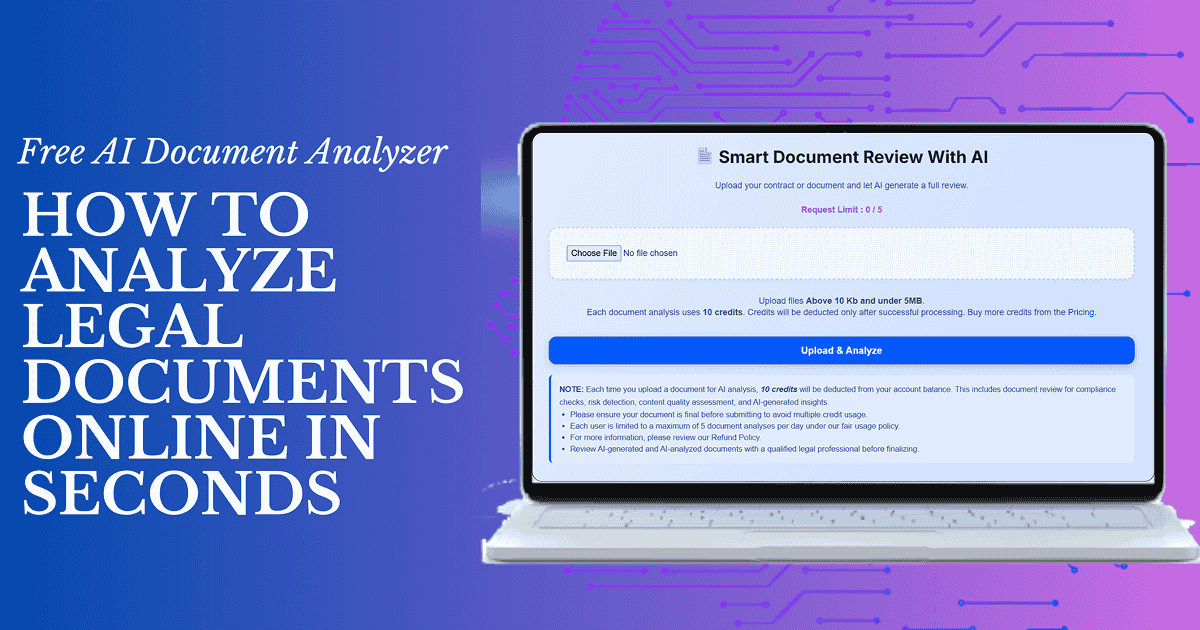
Head to the Indigo e-Docs AI document analyzer page. No signup wall, no credit card upfront.
Step 2: Upload Your Document
Drag and drop your file – PDFs, Word docs, images and scanned documents are all supported. AI automatically OCRs scanned files, so even old paper contracts you had photographed work fine.
Step 3: Let the AI Read It
That’s the magic part. The AI will read the whole document in under a minute (usually much less). A contract of 50 pages? Took about 30 seconds to finish.
Step 4: Review the Analysis
You get a structured breakdown:
- Executive summary of what the document is and what it does
- Key terms and definitions explained in plain English
- Important clauses highlighted (payment, IP, termination, liability)
- Red flags and unusual terms flagged for your attention
- Obligations and deadlines extracted in a clean list
Step 5: Act on What You Find
This is where AI doc analysis actually pays off. You can:
- Negotiate the risky clauses before signing
- Ask the other party for clarification
- Make an informed decision about whether to sign at all
- Save the analysis as a record of what you understood at signing
The whole process takes maybe 2-3 minutes including reading the analysis. This is a no-brainer compared to spending 2-3 hours reading a contract yourself (and probably missing things anyway).
What the AI is Searching For: Clauses, Red Flags & Duties
A good AI document analyzer doesn’t just summarize — it scrutinizes. Here’s what gets flagged:
Critical Clauses It Surfaces
- Payment terms — when, how much, late fees, penalties
- Scope of work — what’s included, what’s extra
- Intellectual property — who owns the work product
- Termination conditions — how either party can exit
- Liability and indemnification — who’s on the hook if something goes wrong
- Confidentiality — what’s protected and for how long
- Dispute resolution — arbitration vs. litigation, governing law
- Auto-renewal triggers — sneaky clauses that keep contracts going
Common Red Flags
- Unlimited liability clauses
- One-sided indemnification (you’re protecting them, they’re not protecting you)
- Vague scope definitions that let scope creep in
- Aggressive non-compete clauses that limit your future work
- Hidden auto-renewal terms with short cancellation windows
- IP assignment overreach — agreements that try to claim ownership of work you did before
- Unusually short payment windows or unfavorable late-fee structures
Obligations Tracking
The AI pulls out every “shall,” “must,” and “will” from the document, organizing them by party. You see a clean list of:
- What you’re obligated to do
- What the other party is obligated to do
- All deadlines and milestones
- Conditions that trigger penalties or termination
This alone is worth its weight in gold. Most contract disputes happen because one party didn’t realize what they’d agreed to.
Free AI Document Analysis vs. Paying a Lawyer: Real Cost Comparison
Let’s be honest about what each option actually delivers:
| Factor | Free AI Document Analyzer | Hiring a Lawyer |
| Cost | $0 | $200–$500/hour |
| Time to results | 30–60 seconds | 2–7 business days |
| Document types supported | Most business contracts | All document types |
| Clause-by-clause breakdown | ✅ Instant | ✅ Available |
| Red flag identification | ✅ Automated, pattern-based | ✅ Manual, judgment-based |
| Plain-English explanations | ✅ Yes | Depends on lawyer |
| Legal advice for your situation | ❌ Informational only | ✅ Yes |
| Court-defensible opinion | ❌ No | ✅ Yes |
| Best for | Routine contracts, NDAs, freelance agreements | Complex deals, M&A, litigation |
The truthful response? Make strategic use of both. Start by running each document through a free AI document analyzer. 95% of standard business agreements will be immediately clear to you without costing you any money.
Bring in a lawyer for the 5% that are truly high-stakes, such as multimillion-dollar transactions, intricate intellectual property transfers, and regulated industries. However, if you have them review a document that has been AI-analyzed, they will spend half the time and bill you half as much because the heavy lifting has already been completed.
Why Free AI Doc Analysis Is Becoming the New Standard
Five years ago, this technology didn’t exist in a useful form. Today, it’s outperforming junior associates on routine contract review tasks. Here’s why it’s exploding:
- Speed — Hours of review compressed into seconds
- Accessibility — No more “I can’t afford a lawyer to look at this”
- Consistency — The AI doesn’t have a bad day or miss a clause because it’s tired
- Volume — Analyze 100 documents in the time it takes a human to read one
- Pattern recognition — Trained on millions of contracts, it spots issues humans miss
For solopreneurs, freelancers, and small businesses, AI business documents analysis has effectively democratized contract review. You no longer need a Big Law retainer to operate professionally.
When AI Document Analysis Isn’t Enough
I’ll keep it real with you — AI doc analysis isn’t a magic wand. Here’s when you still need human eyes:
- Litigation or active disputes — You need a lawyer, period
- Cross-border contracts with complex jurisdictional issues
- Highly regulated industries (healthcare, banking, securities)
- Unique deal structures that don’t follow standard templates
- When you need someone to sign off on legal advice for liability purposes
But for the 80% of routine business documents most of us deal with? An AI document analyzer is genuinely all you need.
Frequently Asked Questions
A: Indeed. You can obtain complete AI analysis for free by uploading documents. Power users can access premium features, but basic document analysis is free.
A: Indigo e-Docs encrypts files in transit and at rest. Files you upload for analysis are deleted automatically after processing; your analysis report is kept in your account until you delete it. As a baseline requirement, trusted tools are built with confidentiality in mind, but always check the privacy policy before uploading anything sensitive.
A: Mostly yes for routine docs. No. Not for complex deals, litigation or specialized legal advice The best way is to use AI for first-pass analysis and a lawyer for high-stakes review – you’ll save thousands.
A: Most modern AI document analyzers handle PDFs, Word documents (.doc, .docx), text files, and scanned images using OCR. If you can read it on a screen, the AI can probably analyze it.
A: Most modern AI document analyzers handle PDFs, Word documents (.doc, .docx), text files, and scanned images using OCR. If you can read it on a screen, the AI can probably analyze it.
A. AI is always better than humans at reviewing routine documents for pattern recognition (identifying clauses, highlighting risks, pulling out obligations). Humans still come out ahead on judgment calls about legal strategy or negotiation positioning. Leverage AI for the grunt work. Use humans for the strategy.
The Bottom Line
One of the most helpful tools to emerge from the AI boom for regular business owners is a free AI document analyzer. You can read a contract in a matter of seconds, identify dangers you might otherwise overlook, and enter every negotiation with a clear understanding of what you’re getting into.
AI document analysis levels the playing field whether you’re reviewing your first freelance contract or processing dozens of vendor agreements every month.
Ready to try it? Upload your document to the Indigo e-Docs AI Document Analyzer and get a complete breakdown in under 60 seconds. Free, secure, and built specifically for legal and business documents. No signup wall. No credit card. Just answers.