Loan Agreement vs. Promissory Note: What’s the Difference, and Which Do You Need?
If you’re lending or borrowing money, the loan agreement vs promissory note question comes up quickly, and people often use the two terms as if they meant the same thing. They don’t. This guide explains what each document does, how they differ, and when one is enough and when you should use both, so you can put the right paperwork in place before any money moves.
What Is a Promissory Note?
A promissory note is a written promise by one person, the borrower, to pay another person, the lender, a specific amount of money. It usually states the amount, the interest rate if there is one, and when the money is due. Typically, only the borrower signs it.
Think of it as an IOU with proper structure. It’s short, often a page or two, and its main job is to prove that the debt exists and that the borrower agreed to repay it. In some countries, a promissory note is also treated as a negotiable instrument, which means it can be transferred to someone else, and that carries its own rules.
What Is a Loan Agreement?
A loan agreement is a full contract between the lender and the borrower. Both sides sign it, and it spells out how the loan works from start to finish: how much is borrowed, how interest is calculated, how and when repayments are made, what happens if a payment is missed and what each party can and can’t do.
Where a promissory note says “I will pay you,” a loan agreement says “here is everything we’ve agreed about this loan.” It runs longer, it covers more scenarios, and it protects both sides rather than just the lender.
Loan Agreement vs Promissory Note: Key Differences
Purpose and Level of Detail
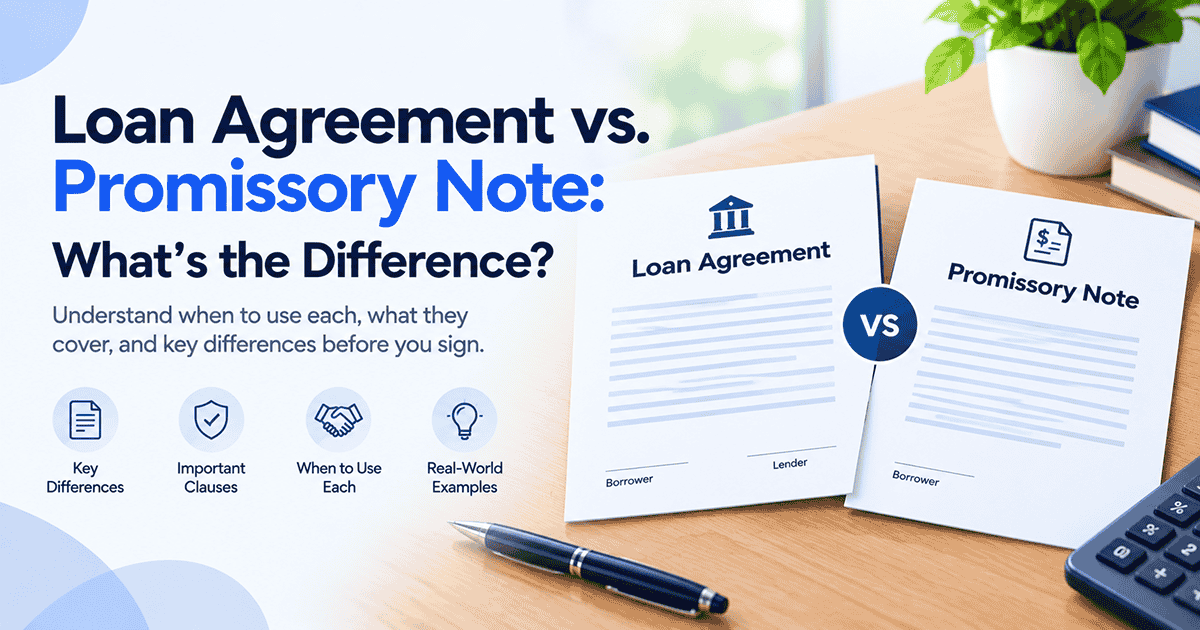
A promissory note records a promise to repay. A loan agreement governs the entire relationship around the loan. If the note is the receipt, the agreement is the rule book.
Who Signs
A promissory note is generally signed by the borrower alone. A loan agreement is signed by both lender and borrower, because both are making commitments.
Length and Complexity
Notes are brief and easy to read. Agreements can run many pages, especially when there is collateral, a guarantor or business conditions attached to the loan.
Terms Covered
A note usually covers the amount, interest, due date and signature. An agreement adds things like repayment schedules, prepayment rules, late fees, collateral, representations, events of default, remedies and governing law.
Protection for Each Side
A note mainly helps the lender prove the debt. An agreement spreads the protection around: the lender gets clear remedies if payments stop, and the borrower gets clarity on what the lender can and cannot do.
When a Promissory Note Is Enough
For simple, low-risk loans, a promissory note may be all you need. Picture lending a friend a modest amount to cover a deposit, to be repaid in three equal installments. The terms fit in a few lines, nothing is pledged as security, and a clear written promise is far better than a handshake.
It’s also common for informal family loans, short-term personal loans and small one-off business advances. If you can describe the whole deal in a few sentences, a note will usually do the job.
When You Need a Loan Agreement
As soon as the deal gets more involved, a loan agreement is the safer choice. Reach for one when the amount is large, when repayment happens in stages, when the loan is secured by collateral or a personal guarantee, or when you want specific conditions attached, such as how the money may be used.
It’s also the better option for business loans, for example a startup borrowing from an investor or a supplier extending credit to a customer. In those cases, you need to know exactly what happens if things go wrong, and a short note rarely answers those questions.
Using Both Together
Plenty of lenders use both documents on the same loan. The loan agreement carries the full terms, and the promissory note is the borrower’s signed promise to pay. The note can be handed back, marked as paid, once the loan is repaid, which gives everyone a clean ending.
If you use both, make sure they agree with each other. A note that states a different interest rate or due date from the agreement is a recipe for dispute, so have the agreement say which document prevails if they ever conflict.
What Every Loan Document Should Include
Whichever document you choose, cover the basics: the full names and addresses of both parties, the loan amount, the interest rate (or a statement that the loan is interest-free), the repayment schedule and final due date, and what happens on late or missed payments. Add any collateral, whether early repayment is allowed, the governing law and signatures with dates.
Two practical points deserve extra care. First, many places limit how much interest a lender can charge, so check local rules before you set a rate. Second, interest-free or low-interest loans, especially between relatives, can have tax consequences in some countries, so it’s worth a quick check for larger sums.
Common Mistakes to Avoid
Relying on a verbal agreement. Memories differ, especially when money is involved. If it isn’t written down and signed, proving it later is hard.
Leaving out the repayment schedule. “I’ll pay you back soon” isn’t a term. Put in dates and amounts.
Using a note when you need an agreement. A one-page note won’t help much if the loan is secured, staged or tied to conditions.
Ignoring local formalities. Some places charge stamp duty, require witnesses or expect registration for certain documents, and getting this wrong can weaken the paperwork. India is one example where stamp duty may apply.
Using a copied template without reading it. A template that says “unsecured loan” is no use if you actually took collateral.
How to Create a Loan Document with Indigo eDocs
You don’t need to start from a blank page. Indigo eDocs offers a Loan Agreement form with guided fields, and you can also describe the deal in plain words in Create with Indigo AI and review the draft it produces. If you need a simpler promissory note, you can describe that in a prompt as well. It suits freelancers, small businesses and anyone handling financial documents without a big legal budget.
Step 1: Choose your document. Pick the loan agreement form or start with an AI prompt.
Step 2: Select your country and language. The draft is tailored to the jurisdiction you choose.
Step 3: Enter the loan details. Add the parties, amount, interest, repayment schedule and any collateral.
Step 4: Review, edit and download. Read it carefully, change anything that doesn’t match your deal and download it as a PDF.
Step 5: Sign it. Both parties can sign electronically with IndigoESign. If someone sends you a loan document, you can also run it through the AI Document Analyzer to see the key clauses and risks before you sign.
When to Get Professional Advice
A generated draft is a solid starting point for a straightforward personal or small business loan. Talk to a lawyer or accountant if the amount is large, if the loan is secured by property, if several parties are involved, or if tax or regulatory questions come up. Indigo eDocs is a drafting tool, not a law firm, and this article is general information rather than legal or financial advice.
Frequently Asked Questions
Q1.What is the main difference between a loan agreement and a promissory note?
A: A promissory note is a short, one-sided written promise by the borrower to repay a set amount. A loan agreement is a longer, two-sided contract that sets out all the terms of the loan, including interest, repayment schedule, collateral, default and remedies, and is signed by both lender and borrower.
Q2. Do I need both a loan agreement and a promissory note?
A: Not always. A simple, small loan may only need a promissory note. For larger or more complex loans, many lenders use a loan agreement for the full terms and a promissory note as the borrower’s signed promise to pay.
Q3. Is a promissory note legally binding?
A: Generally, yes, as long as it is clear, states the amount and repayment terms, and is properly signed by the borrower. The exact rules depend on where you are, so check local requirements such as stamp duty, witnesses or notarization.
Q4. Can I use a promissory note for a loan between friends or family?
A: Yes, and it’s a good idea. Writing the terms down avoids misunderstandings and gives both sides a record. For larger sums, consider a fuller loan agreement and check whether any tax or interest-rate rules apply.
Q5. Do loan documents need to be notarized or witnessed?
A: It depends on the country, the type of loan and the amount. Notarization or witnesses are not always required, but they can make a document easier to prove later. If the loan is secured by property, additional formalities usually apply.
Final Thoughts
The difference comes down to scope. A promissory note is a short promise to repay, and a loan agreement is the full set of rules for the loan. Use a note for simple, low-risk loans, an agreement when the deal is bigger or more complicated, and both when you want the strongest paper trail.
Ready to put your loan in writing? Create your loan agreement with Indigo eDocs and have a draft ready in minutes.