Service Agreement vs Contract: What’s the Difference?
A service agreement vs contract comparison can be confusing because the two terms are often used interchangeably in business. A service agreement is a type of contract that explains the services one party will provide to another, along with important terms such as payment, responsibilities, deadlines, confidentiality, and termination. Understanding the difference can help businesses, freelancers, and clients choose the right document for their working relationship.
Whether you are hiring a freelancer, working with a consultant, outsourcing business services, or providing professional services to a client, having the right agreement can help clearly define what each party expects.
What Is a Contract?
A contract is a legally enforceable agreement between two or more parties that establishes certain rights and obligations.
Contracts can cover many different types of relationships and transactions. For example, a contract may be used for:
- Buying or selling goods
- Hiring employees
- Leasing property
- Providing professional services
- Purchasing business assets
- Establishing partnerships
- Protecting confidential information
A contract generally identifies the parties involved, explains what each party has agreed to do, and establishes the terms that govern the relationship.
Depending on the situation and applicable law, a contract may include terms covering payment, delivery, performance, confidentiality, warranties, liability, dispute resolution, termination, and governing law.
The important point is that “contract” is a broad term. A service agreement is one specific type of contract designed primarily around the provision of services.
What Is a Service Agreement?
A service agreement is a contract between a service provider and a client that defines the services to be provided and the terms under which those services will be delivered.
For example, a service agreement may be used when a business hires:
- A marketing agency
- A software developer
- A consultant
- An accountant
- A designer
- A cleaning company
- A maintenance provider
- An independent professional
The agreement can explain exactly what the provider will deliver, how much the client will pay, when payments are due, how long the relationship will last, and what happens if either party wants to end the arrangement.
A well-structured service agreement can reduce misunderstandings by putting important expectations in writing before work begins.
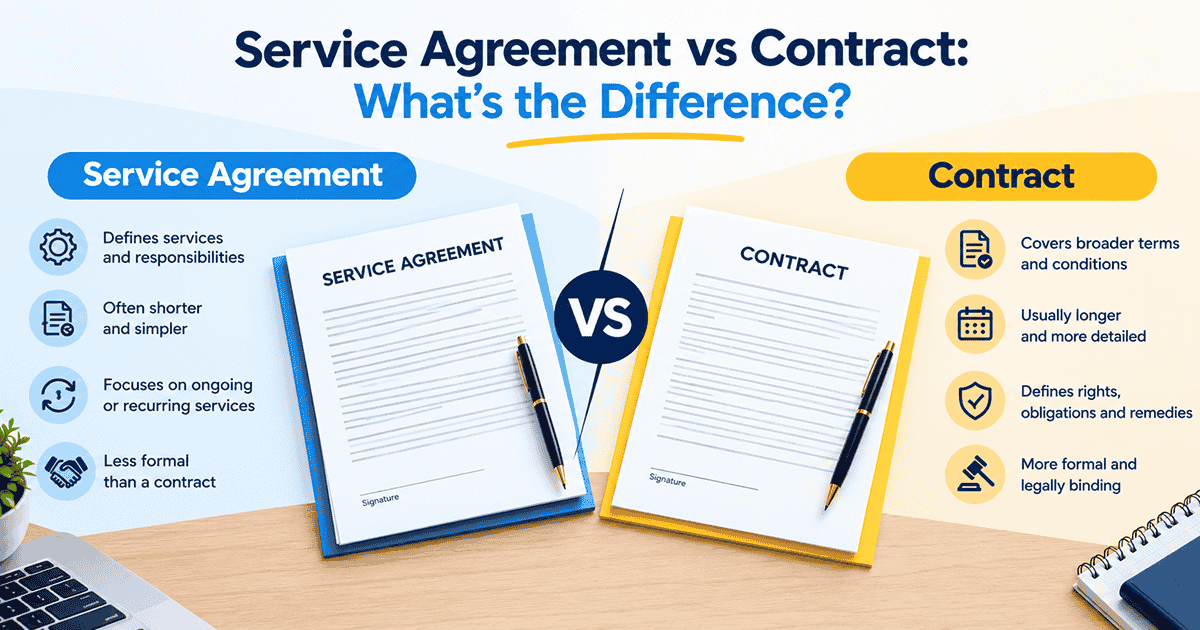
Service Agreement vs Contract: The Main Difference
The simplest way to understand the service agreement vs contract difference is to think about scope.
A contract is a general legal term that can describe many types of agreements.
A service agreement is a specific type of contract focused on the delivery of services.
For example, an employment contract establishes terms between an employer and employee. A lease agreement establishes terms for renting property. A purchase agreement can establish the terms for buying or selling an asset.
A service agreement, on the other hand, focuses on a service relationship between a provider and a client.
So, every service agreement is a contract, but not every contract is a service agreement.
Service Agreement vs Contract: Key Differences
Although a service agreement is a type of contract, there are some practical differences in how these documents are used.
1. Purpose
A general contract can be created for many purposes, including employment, sales, leases, partnerships, and other transactions.
A service agreement specifically focuses on the performance of services.
2. Scope of Work
Service agreements usually provide detailed information about the services being delivered.
This may include:
- Description of services
- Deliverables
- Project milestones
- Service standards
- Deadlines
- Client responsibilities
- Provider responsibilities
A general contract may or may not require this level of service-specific detail.
3. Payment Terms
Because service agreements involve ongoing or one-time services, payment provisions are usually an important part of the document.
A service agreement may explain:
- Total fees
- Hourly or project-based rates
- Payment schedule
- Invoicing requirements
- Late-payment terms
- Expenses
- Taxes
Clear payment terms can help prevent disagreements later.
4. Duration
A service agreement often establishes how long the service relationship will continue.
It may be:
- For a specific project
- For a fixed period
- Month-to-month
- Automatically renewable
- Ongoing until terminated
The contract can also specify how much notice must be given before termination.
5. Client and Provider Responsibilities
Service agreements commonly define responsibilities for both parties.
For example, a client may be required to provide information, access, approvals, or materials needed to complete the work.
The service provider may be responsible for completing specific deliverables within agreed deadlines.
Clearly defining these responsibilities can make the working relationship easier to manage.
What Should a Service Agreement Include?
The exact terms depend on the type of services and the parties involved, but a service agreement commonly includes the following sections.
Parties to the Agreement
Identify the service provider and client using their correct legal names and relevant contact information.
Description of Services
Clearly explain what services will be provided.
Avoid vague descriptions such as “marketing services” when more detail can be provided. Instead, identify the specific work, deliverables, or responsibilities covered by the agreement.
Scope of Work
The scope of work establishes what is included and, where appropriate, what is outside the provider’s responsibilities.
This can be particularly important for projects where additional work may result in additional charges.
Fees and Payment
Explain how much the client will pay and when payment is due.
If there are additional expenses, deposits, milestones, or late-payment provisions, these should also be addressed.
Term and Termination
State when the agreement begins and how long it will remain effective.
The termination section can explain when either party can end the agreement and whether advance written notice is required.
Confidentiality
If the provider will receive access to confidential business information, the agreement may include confidentiality obligations.
Depending on the situation, a separate NDA may also be appropriate.
Intellectual Property
The agreement should clarify ownership or permitted use of work created during the engagement.
This can be especially important for software, designs, written content, marketing materials, photographs, and other creative or technical work.
Limitation of Liability
Depending on the applicable law and circumstances, the agreement may include provisions addressing the parties’ potential liability.
These provisions should be drafted carefully because enforce-ability can vary by jurisdiction.
Dispute Resolution
The agreement can explain how disputes will be handled, such as through negotiation, mediation, arbitration, or court proceedings, depending on the parties’ requirements and applicable law.
Governing Law
A governing-law provision identifies which jurisdiction’s laws will generally apply to the agreement.
The appropriate wording depends on the parties and the transaction.
When Should You Use a Service Agreement?
A service agreement can be useful whenever one party is providing services to another and the relationship involves important responsibilities, payments, deadlines, or deliverables.
For example, a service agreement may be appropriate when:
- A freelancer starts work for a client
- A consultant provides professional advice
- An agency manages marketing activities
- A developer builds software
- A company outsources administrative work
- A contractor provides ongoing maintenance
- A business hires an external service provider
For very simple or low-risk arrangements, parties may use shorter agreements. For complex projects or higher-risk engagements, a more detailed agreement may be appropriate.
Service Agreement vs Employment Contract
A service agreement should not automatically be treated as an employment contract.
A service agreement is generally used to establish a relationship where one party provides specified services to another. An employment contract, by contrast, establishes an employment relationship and addresses matters such as compensation, job duties, benefits, working conditions, and other employment terms.
The legal classification of a worker depends on the applicable law and the actual circumstances of the relationship, not simply on the title of the document.
If you are unsure whether a worker should be classified as an employee or independent contractor, consider obtaining advice from a qualified legal or employment professional.
Common Mistakes in Service Agreements
Even when businesses use a service agreement, unclear terms can create problems.
Vague Scope of Work
If the agreement does not clearly explain what the provider must deliver, disagreements may arise about what was included in the price.
Unclear Payment Terms
Terms such as “payment upon completion” can create confusion if completion is not clearly defined.
Specify payment amounts, due dates, milestones, or other relevant conditions.
Missing Termination Terms
Both parties should understand how the relationship can end.
A clear termination clause can explain notice requirements and what happens to outstanding payments or unfinished work.
Ignoring Intellectual Property
Businesses should consider who owns or can use materials created during the engagement.
This is particularly important when the provider creates designs, software, content, branding, or other intellectual property.
Using a Generic Template Without Reviewing It
A template can provide a useful starting point, but it may not address the specific circumstances of every business relationship.
Review the document carefully and adapt relevant terms to the actual services, parties, location, and transaction.
Can You Create a Service Agreement Online?
Yes. Businesses and individuals can use online document-generation tools to create a starting draft based on their requirements.
Indigo e-Docs provides an AI-powered document generator along with a form-based document builder for contracts, agreements, and other legal documents. Users can describe what they need, generate a draft, customize it, and download the resulting document. (Indigo e-Docs)
For a service agreement, the information you may need to provide includes:
- Service provider information
- Client information
- Description of services
- Deliverables
- Fees
- Payment schedule
- Start and end dates
- Termination requirements
- Confidentiality requirements
- Intellectual property terms
AI-assisted document tools can help create an initial draft more efficiently, but the final document should be reviewed for the specific transaction and applicable jurisdiction before it is signed.
Final Thoughts
The service agreement vs contract distinction is easier to understand when you remember that a service agreement is a specific type of contract.
A contract can cover many different legal or business relationships, while a service agreement focuses specifically on services provided by one party to another.
Before signing a service agreement, review the scope of work, payment terms, responsibilities, duration, termination provisions, confidentiality, intellectual property, and other terms that matter to the relationship.
A clear agreement can help both parties understand their responsibilities and reduce avoidable misunderstandings.
If you need to create a service agreement, Indigo e-Docs can help you generate and customize an AI-assisted document draft based on your requirements. As with any legal document, consider having the final version reviewed by a qualified legal professional when the agreement involves significant legal or financial obligations.
Frequently Asked Questions
Q1. Is a service agreement the same as a contract?
A: A service agreement is a type of contract. The term “contract” is broader and can refer to many different agreements, while a service agreement specifically covers the provision of services between a provider and client.
Q2. What should a service agreement include?
A: A service agreement commonly includes the parties’ information, services and scope of work, fees, payment terms, duration, termination provisions, confidentiality, intellectual property, liability, dispute resolution, and governing law.
Q3. When should I use a service agreement?
A: A service agreement can be useful when a freelancer, consultant, agency, contractor, or other service provider is performing work for a client. It can clarify responsibilities, deliverables, payment, deadlines, and other important terms.
Q4. Can I create a service agreement online?
A: Yes. Online document tools can help you create a service agreement draft using templates, guided forms, or AI-assisted document generation. The completed document should be reviewed and customized for the specific relationship and applicable legal requirements.
Q5. Is a service agreement legally binding?
A: A service agreement may form a legally enforceable contract when applicable legal requirements are satisfied, but enforce-ability depends on factors such as the agreement’s terms, how it was formed and executed, the parties, and applicable law. Consider consulting a qualified legal professional for advice about a specific agreement.
Create Your Next Legal Document
If you are ready to create a structured first draft for your business or client relationship, Indigo e-Docs offers AI-powered tools for several common legal documents:
AI Service Agreement Generator · AI Employment Contract Generator · AI Partnership Agreement Generator · AI Lease Agreement Generator · AI NDA Generator
Read Next
AI Contract Drafting: How It Works and What to Know — learn how AI-assisted tools can help create a structured first draft while keeping legal review in the process.