Write a non-disclosure agreement in 60 seconds — not 60 minutes
You’re meeting a prospective client on Thursday. They want to see the way your process works. You want to show them, but you don’t want to give the whole thing to somebody who might walk away and rebuild it themselves.
That is what an NDA is for, and it should not take a week and a legal invoice to get one.
Describe what you are protecting and who you are protecting it from. Indigo AI drafts a complete non-disclosure agreement — mutual or one-way, written for your country and in your language — and you download it as a PDF, ready to sign.
 Drafted in about 60 seconds ·
  Country, state and language selection ·
  Download as PDF · ✍️ Sign free with IndigoESign
What an NDA actually does
A non-disclosure agreement is a contract where one or both parties agree not to share specific information with anyone outside the agreement. It is one of the most common business documents in existence, and one of the most frequently signed without being read.
The value of an NDA is not the intimidation factor. It is the paper trail. A signed NDA establishes three things that are otherwise very hard to prove later: that the information was confidential, that the other party knew it was confidential, and that they accepted a duty to keep it that way. Without that, a disclosure dispute becomes one person’s word against another’s.
There are two shapes it usually takes.
A one-way NDA (or unilateral NDA) protects one party. You’re the one giving. They’re the one taking. This is the standard choice when you are pitching to an investor, briefing a contractor or showing a supplier your specifications.
Both sides are covered by a mutual NDA. Both sides are expecting to share something intimate. This lends itself to partnership talks, merger discussions, joint product development, or any discussion where both people come with something to lose.
A common, avoidable mistake is choosing the wrong one. When a partner is about to share their own roadmap and you send a one-way NDA, it feels one-sided and usually kills the conversation before it starts.
Why use an AI NDA generator
It removes the blank page. Most people do not struggle with the concept of an NDA. They struggle with the first sentence. Starting from a complete, structured draft means your job becomes editing rather than authoring, and editing is far faster.
It is drafted for where you are. Confidentiality law is not identical everywhere. Enforceability of restrictive terms, expected notice periods, and the way courts read overly broad definitions all vary. Indigo AI asks for your country, state, and preferred language before it drafts, so you are not adapting a US template for an Indian transaction by hand.
It covers the clauses people forget. A generic template downloaded from a search result often omits the return-or-destroy clause, says nothing about what happens to information already in the public domain, and forgets to name a governing jurisdiction. Those omissions matter precisely when the agreement is being tested.
It is fast enough to actually use. The honest reason many NDAs never get signed is friction. If protecting a conversation takes two days, people skip it and share anyway. Sixty seconds removes that excuse.
You can start free. New accounts include credits to generate straight away. A short NDA costs 1 credit; a medium-length one costs 2. There is no subscription—credit packages start at $5 for 50 credits, and you buy more only when you need them.
How it works
Step 1 — Choose your input method
Type a prompt describing what you need. Tap the microphone and dictate it instead. Or upload an existing document — a PDF, JPG, PNG or WEBP — and let the AI read it and build from there. Uploaded files are processed securely and deleted automatically after use.
Step 2 — Set your jurisdiction and language
Select Business & Corporate from the seven document categories, then pick your country, state and language. This is what separates a drafted document from a downloaded one — the output is written for your context, not a generic one.
Step 3 — Describe what you are protecting
You do not need legal phrasing. Something like this works:
Mutual NDA between my design studio and a manufacturing partner in Pune. We will both be sharing product designs, pricing and supplier lists. Confidentiality should last three years after the agreement ends. Governed by Indian law.
Step 4 — Review, edit and download
The draft appears in about a minute. Every clause is editable before you download. Adjust the term, tighten the definition of confidential information, change the notice address — then download your PDF.
Step 5 — Sign it
Take the finished NDA to IndigoESign and collect signatures free, without printing anything.
What your generated NDA includes
A complete NDA from Indigo AI is structured around the clauses that determine whether the agreement holds up:
- Parties and effective date — who is bound, and from when
- Definition of confidential information — the most important clause in the document, and the one most templates get wrong by being either uselessly vague or so narrow it excludes the thing you cared about
- Exclusions — information already public, information the recipient already had, information independently developed, and information they receive lawfully from someone else
- Permitted disclosures — usually to employees and advisers who need to know and are bound by equivalent duties
- Obligations of the receiving party — the actual duty of care, including how the information must be stored and handled
- Term and survival — how long the agreement runs, and how long confidentiality outlives it
- Return or destruction of materials — what happens to documents, files and copies when the relationship ends
- No licence or transfer of rights — confirming that sharing information does not give the other party any ownership of it
- Governing law and jurisdiction — which country’s law applies and where disputes are heard
- Remedies — including injunctive relief, because damages alone rarely fix a leak
- Signature blocks for both parties
Example: what a generated NDA looks like
Prompt entered:
One-way NDA. I am a freelance developer in Bangalore about to receive access to a fintech client’s internal API documentation and customer data schema. Two-year confidentiality period. Indian jurisdiction, Karnataka.
What Indigo AI returns:
A unilateral non-disclosure agreement naming the client as the disclosing party and you as the receiving party. The definition of confidential information covers technical documentation, source code, data schemas and customer information, whether marked confidential or not. Exclusions cover anything already public or independently developed. The obligations clause requires the same standard of care you apply to your own confidential material, and no less than reasonable care. A two-year term is set, with confidentiality surviving termination. A return-and-destroy clause requires deletion of all copies within a defined notice period. Governing law is set to India, with jurisdiction in Karnataka. Signature blocks are formatted for both parties.
Roughly 1,100 words. Generated in under a minute. Editable before you download it.
Who uses this
Freelancers and consultants who receive client material and need to show they take confidentiality seriously — often the difference between winning a contract and being passed over. See our dedicated guide on NDAs for freelancers.
Startups raising money or talking to potential acquirers, where the conversation itself reveals strategy. Our NDA for startups page covers what investors will and will not sign.
Employers onboarding staff who will handle customer data, pricing or internal processes. Read more on NDAs for employees.
Agencies and studios briefing subcontractors on client work they are contractually required to protect.
Manufacturers and product companies sharing specifications, tooling details or supplier relationships.
Mistakes worth avoiding
Defining confidential information as “all information.” Courts tend to read sweeping definitions unfavourably. If everything is confidential, nothing is clearly confidential. Name the categories that matter.
Leaving out a term. An NDA with no end date is not automatically stronger. In several jurisdictions it is harder to enforce, not easier. A defined period — two, three, five years — is usually more robust than perpetuity.
Forgetting the exclusions. Without them, you are technically asking the other party to keep secret things that are already on your website.
Signing before reading. If someone sends you their NDA, run it through the AI Document Analyzer first. It flags clauses, obligations and risks in seconds, which is more than most people manage reading it themselves at the end of a long day.
Assuming an NDA replaces a contract. It protects information. It does not set scope, payment terms or deliverables. You will still need the actual agreement.
Frequently Asked Questions
Is the AI NDA generator free? You can start free — new accounts receive credits to generate straight away. A short NDA uses 1 credit and a medium-length one uses 2. There is no subscription. When you need more, credit packages start at $5 for 50 credits.
Is an AI-generated NDA legally binding? An NDA becomes binding through proper execution by the parties, and its enforceability depends on your jurisdiction and the specific circumstances. IndigoEDocs produces a professionally structured, AI-assisted draft — we strongly recommend having it reviewed by a qualified legal professional or your relevant legal authority before signing.
Should I use a mutual or one-way NDA? Use one-way when only you are sharing sensitive information. Use mutual when both sides will disclose. If you are unsure, mutual is usually the safer choice for partnership and negotiation conversations, because it does not signal distrust.
Can I create an NDA for a country outside the US? Yes. You select your country, state and language before the document is drafted, and the AI writes accordingly.
How long should an NDA last? Two to five years is common for commercial information. Trade secrets are sometimes protected for longer. The right term depends on how long your information stays valuable — pricing may be stale in a year, a manufacturing process may not be.
Can I edit the NDA after it is generated? Yes. Every clause is editable before download. You can adjust the term, redefine confidential information, change the governing law, or rewrite any section.
What format do I get? Your NDA downloads as a PDF, ready to print or sign electronically.
How do I get it signed? Use IndigoESign to send it for signature free — no printing or scanning required.
Is my information private? Your documents are stored in your private account and only you can access them. We never share or sell your data, and you can permanently delete any document at any time. Uploaded files are deleted automatically after processing.
Related documents
- Free NDA Template — a manual starting point if you prefer to fill in a form
- Non-Compete Agreement — restricts competing activity, not just disclosure
- Independent Contractor Agreement — the full agreement your NDA sits alongside
- AI Employment Contract Generator — for staff who need confidentiality terms built in
- AI Partnership Agreement Generator — when the conversation turns into a business
- AI Document Analyzer — review an NDA someone sent you
Protect the conversation before you have it
An NDA you never got round to writing protects nothing. This one takes about a minute.
New accounts start with free credits · No subscription · View pricing
Please note: IndigoEDocs produces AI-assisted drafts designed to get you most of the way there quickly. For any agreement that carries real commercial risk, have the final document confirmed by a qualified legal professional or your relevant legal authority before execution.
Types of Power of Attorney: Which One Do You Need?
Loan Agreement vs Promissory Note: Which One Do You Need?
Privacy Policy for Website: What to Include
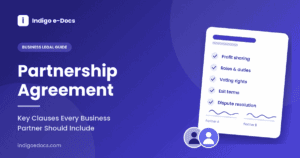
Partnership Agreement Clauses You Need