Offer letter vs employment contract: key differences explained
Offer letter vs employment contract is one of the most common questions employers and job seekers ask once a hiring decision has been made. Both documents describe the terms of a job, yet they serve different purposes, contain different levels of detail, and can create different legal obligations. In this guide, you will learn what each document is, how they differ, when you need one or both, and which mistakes to avoid so that a simple hire does not turn into a dispute.
What Is an Offer Letter?
An offer letter is a short, formal document in which an employer confirms that it wants to hire a candidate and outlines the main terms of the role. Think of it as the written version of the conversation that happens at the end of the hiring process. It is usually one or two pages long, written in a friendly but professional tone, and sent soon after the final interview.
The main job of an offer letter is speed and clarity. It lets the candidate see the headline terms in writing, decide whether to accept, and plan their notice period with their current employer. For the employer, it locks in a good candidate before a competitor does.
What an Offer Letter Usually Includes
- Job title and department
- Start date and work location
- Salary or hourly rate and pay frequency
- Key benefits such as leave, insurance, or bonus eligibility
- Conditions of the offer, such as background checks or reference checks
- A deadline for accepting the offer
- A signature section for acceptance
Most offer letters avoid long legal clauses. They give the essentials and, in many cases, mention that a formal employment agreement or company policies will follow.
What Is an Employment Contract?
An employment contract is a legally binding agreement between an employer and an employee that sets out the full terms of the working relationship. Where the offer letter says, “We would like to hire you on these basic terms,” the employment contract says, “Here is exactly how this relationship will work, and what happens if something goes wrong.”
Because it is meant to be the definitive record, an employment contract is more detailed, more carefully worded, and often reviewed by a lawyer or generated from a reliable template. It protects both sides: the employee gets certainty about pay, duties, and notice, while the employer gets protection for its confidential information and business interests.
Clauses Commonly Found in an Employment Contract
- Detailed job description and reporting line
- Compensation, bonuses, and payment schedule
- Working hours, overtime, and leave entitlements
- Probation period and performance expectations
- Confidentiality and intellectual property clauses
- Non-compete and non-solicitation terms, where the law allows them
- Notice period and termination conditions
- Dispute resolution and governing law
- An entire agreement clause
If you are creating one for the first time, our guide on how to create an employment contract walks through what to include and what to avoid.
Offer Letter vs Employment Contract: Key Differences
The easiest way to understand the difference is to compare the two documents point by point. The list below summaries what matters most in practice.
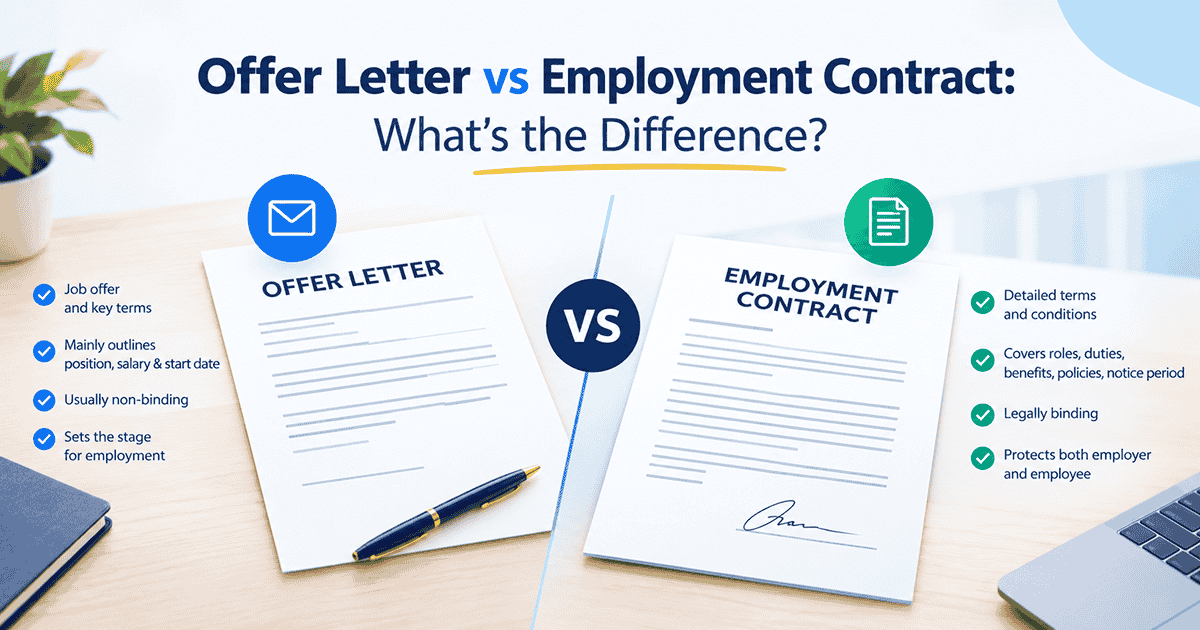
- Purpose: An offer letter confirms the job offer and headline terms, while an employment contract defines the full legal relationship.
- Length: An offer letter is usually one to two pages, while a contract often runs four to fifteen pages or more.
- Level of detail: An offer letter covers the basics such as role, pay, start date, and conditions. A contract covers duties, notice, confidentiality, and termination.
- Legal weight: An offer letter may be binding depending on its wording and local law, while a contract is a binding agreement once both parties sign it.
- Timing: An offer letter comes at the end of the hiring process, while a contract is signed after acceptance or on joining.
- Who it protects: An offer letter mainly gives the candidate clarity, while a contract protects both employer and employee.
- Tone: An offer letter is friendly and concise, while a contract is formal and precise.
In short, the offer letter starts the relationship and the employment contract defines it. Many employers use both, in that order.
Is an Offer Letter Legally Binding?
This is where many people get caught out. An offer letter is not automatically a full contract, but it is not always harmless either. Depending on the country or state, an accepted offer letter can create legal obligations, especially if it contains firm promises about pay, role, or start date and the candidate relied on those promises.
For example, if a candidate resigns from a stable job after receiving an unconditional offer, and the employer then withdraws it without a valid reason, the candidate may have grounds for a claim. To manage this risk, employers should use careful wording, state any conditions clearly, and avoid promising anything they are not ready to deliver.
Employees should also read the letter closely. If something important, such as a promised bonus or remote work arrangement, is missing, ask for it to be added before you accept.
Do You Need Both Documents?
There is no single rule that applies everywhere. Some employers send only an offer letter and rely on company policies or local law for everything else. Others skip the offer letter and send a full contract straight away. A two-step approach is often the most practical for the following reasons.
- Speed: The offer letter can be sent the same day, so you do not lose your preferred candidate while the contract is being prepared.
- Clarity: The candidate understands the main terms before investing time in reading a long agreement.
- Protection: The employment contract then records the detailed terms, including confidentiality, termination, and dispute clauses.
- Consistency: Using the same contract template for every hire reduces mistakes and unequal treatment.
If you only use one document, make sure it is detailed enough to cover pay, duties, notice, and confidentiality. A vague offer letter on its own often leaves gaps that are expensive to fix later.
Which Document Fits Your Situation?
Small Businesses and Startups
Small teams often need to hire quickly. An offer letter followed by a simple, plain-language employment contract is usually enough. Make sure the contract covers confidentiality and intellectual property, because early-stage companies depend heavily on both.
Senior and Specialist Roles
For leadership or technical roles, a basic offer letter will rarely be enough. These hires often involve equity, bonuses, non-compete terms, or long notice periods, so a full employment contract reviewed by a legal professional is the safer choice.
Freelancers and Contractors
A freelancer is not an employee, so an employment contract is usually the wrong document. A contractor agreement, often paired with an NDA, is the better fit. Our guide on an NDA for an independent contractor explains how to protect your information in that situation.
Common Mistakes to Avoid
- Using vague language: Phrases like “competitive salary” or “performance bonus” without figures or conditions cause disagreements.
- Skipping conditions: If the offer depends on references, background checks, or work eligibility, say so clearly.
- Letting documents conflict: Pay, job title, and notice terms should match across the offer letter and the contract.
- Copying an outdated template: Employment rules change, and a template from several years ago may no longer meet current requirements.
- Ignoring local law: Notice periods, probation limits, and non-compete rules differ from place to place.
- Not keeping signed copies: Both sides should store the signed documents safely for future reference.
Remember that this article is general information and not legal advice. For high-value or complex hires, speak with a qualified employment lawyer in your jurisdiction.
How to Draft Both Documents Faster
Writing these documents from scratch can take hours, and small errors are easy to miss. With the Indigo e-Docs Employment Contract Generator, you can describe the role in plain language and get a structured draft in about 60 seconds. You can then review it, adjust the terms, and use it as the foundation for your hiring paperwork. If you already have a contract from a candidate or employer, the AI Document Analyzer can help you spot risky or unclear clauses before you sign.
Frequently Asked Questions
Is an offer letter the same as an employment contract?
No. An offer letter is a short document that confirms the key terms of a job offer, such as title, pay, and start date. An employment contract is a longer, more detailed agreement that sets out the full rights and obligations of both the employer and the employee. Some employers use a detailed offer letter as the contract, but the two are not automatically the same thing.
Is an offer letter legally binding?
It can be. Whether an offer letter is binding depends on its wording and on local law. If it uses firm language, is accepted by the candidate, and the candidate relies on it, for example by resigning from another job, it may create enforceable obligations. Adding a clear statement that the offer is conditional helps reduce confusion.
Can an employer withdraw an offer letter?
Often yes, particularly when the offer is conditional on background checks, references, or proof of the right to work. However, withdrawing an offer after the candidate has accepted it and acted on it can lead to disputes in some jurisdictions. Employers should state the conditions clearly and seek legal advice before withdrawing an accepted offer.
Do I need both an offer letter and an employment contract?
Not always, but using both is a common and practical approach. The offer letter secures the candidate quickly with the headline terms, and the employment contract follows with the complete legal terms. Small teams hiring for simple roles may combine them into one detailed document.
What happens if my offer letter and employment contract conflict?
The signed employment contract usually takes priority, especially if it contains an entire agreement clause stating that it replaces earlier documents. To avoid problems, compare both documents before signing, and ask the employer to correct any difference in pay, role, or notice terms in writing.