
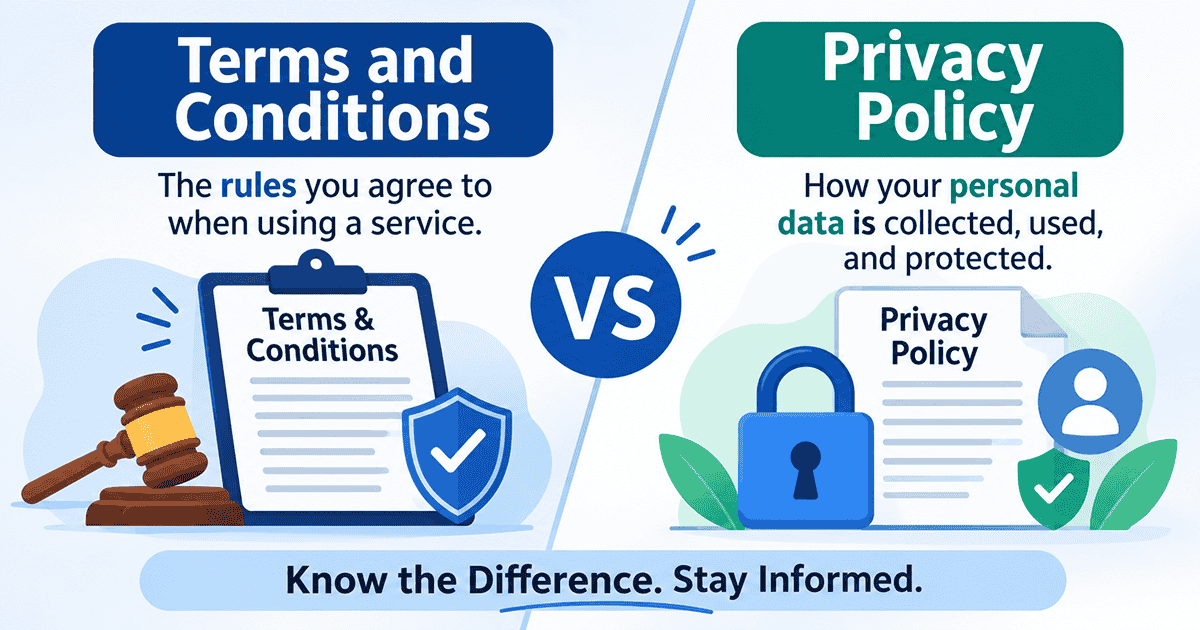
Terms and Conditions vs Privacy Policy: What’s the Difference?
Terms and conditions vs privacy policy is a question almost every website owner faces at launch. Both are legal pages, both usually sit in your website footer, and both use formal language, so it is easy to assume they do the same job. They do not. One sets the rules for how people use your site or service, while the other explains what you do with their personal data. Understanding the difference helps you stay compliant, protect your business, and build trust with visitors. In this guide, we break down what each document does, how they differ, what to include, and whether you need both.
What Is a Terms and Conditions Agreement?
Terms and conditions (also called terms of service or terms of use) is a legal agreement between your business and the people who use your website, app, or service. It sets the ground rules, much like house rules for your digital property.
A strong T&C page explains what users can and cannot do, how accounts and payments work, what happens when someone breaks the rules, and where your responsibility ends. Because it controls behavior and limits risk, it mainly protects you as the business owner.
You need it most if you sell products, offer subscriptions, run a marketplace, host user-generated content, or provide software. A simple personal blog may not strictly require one, but adding it is still a smart habit.
What Is a Privacy Policy?
A privacy policy is a disclosure document. Instead of setting rules for users, it tells them how you collect, use, store, share, and protect their personal information. That includes obvious data like names and email addresses, and less obvious data like IP addresses, cookies, analytics identifiers, and payment details.
Unlike T&C, a privacy policy is often required by law. Regulations such as the GDPR in Europe, the CCPA/CPRA in California, and India’s Digital Personal Data Protection Act place transparency duties on any site that handles personal data. Platforms like Google Analytics, Google AdSense, and the major app stores also require you to link to one.
Want the full checklist? Read our detailed guide on what to include in a privacy policy for your website.
Terms and Conditions vs Privacy Policy: Key Differences
The quickest way to see the gap is a side-by-side comparison.
- Main purpose: Terms and conditions set the rules for using your site or service. A privacy policy explains how personal data is handled.
- Legally required? T&C is usually not mandatory, but strongly recommended. A privacy policy is often mandatory by law and by platforms.
- Who it mainly protects: T&C protects the business. A privacy policy protects the user, and shields the business from penalties.
- Typical content: T&C covers accounts, payments, disclaimers, liability, and disputes. A privacy policy covers data collection, cookies, sharing, retention, and user rights.
- How users agree: T&C is often accepted by a checkbox or an “I agree” click. A privacy policy is acknowledged, with extra consent for certain data uses.
- Tone: T&C speaks in rules and obligations. A privacy policy speaks in transparency and disclosure.
1. Purpose and Focus
Terms and conditions govern behavior. They answer questions like “What am I allowed to do here?” and “What happens if I break the rules?” A privacy policy governs data. It answers “What information do you collect about me, and why?”
2. Legal Requirement
This is the biggest practical difference. If you collect any personal data, even just emails through a contact form, a privacy policy is typically a legal necessity. T&C, on the other hand, is mostly a protective choice. No law forces a blogger to publish one, but not having it leaves you exposed.
3. Who Each Document Protects
T&C shields the business by limiting liability, controlling misuse, and setting dispute rules. A privacy policy protects the user’s rights over their data, though it also protects you by showing you acted transparently if a regulator comes asking.
4. How Users Agree
T&C is usually enforced through “clickwrap,” where users tick a box at sign-up or checkout. Courts tend to favor this because it shows clear consent. Privacy policies are often accepted by continued use, but laws like the GDPR require explicit consent for specific uses, such as marketing emails or non-essential cookies.
Do You Need Both?
In most cases, yes. If your website collects personal data, you need a privacy policy. If your website sells anything, accepts payments, offers accounts, or allows user content, you also want terms and conditions.
Think of it this way: the privacy policy keeps you compliant, and the T&C keeps you protected. Together they cover the two biggest risks of running a website, which are regulatory trouble and user disputes.
Even a small freelancer portfolio benefits from both. A contact form collects personal data, and a service page invites commercial activity. If you work with clients directly, you may also need formal agreements, and our comparison of service agreement vs contract explains where those fit.
What to Include in Terms and Conditions
A solid T&C page should cover:
- Acceptance of terms: how and when users agree to the rules
- User responsibilities: acceptable use and prohibited activities
- Account terms: registration, security, and termination rights
- Payments and refunds: pricing, billing cycles, and refund conditions
- Intellectual property: who owns the content, logos, and software
- Disclaimers and limitation of liability: what you are not responsible for
- Governing law and dispute resolution: which jurisdiction applies
- Changes to terms: how you notify users of updates
What to Include in a Privacy Policy
A compliant privacy policy should explain:
- What data you collect: personal details, device data, cookies, and payment information
- Why you collect it: service delivery, marketing, analytics, or legal duties
- How you share it: third-party tools, processors, and advertisers
- How long you keep it: retention periods and deletion practices
- User rights: access, correction, deletion, and opt-out options
- Security measures: how you protect stored information
- Cookie usage: types of cookies and how to manage them
- Contact details: who to reach for privacy questions
Common Mistakes to Avoid
Many website owners treat these pages as a box to tick. That is where problems start.
Copying another website’s text. Every business handles data and risk differently. A copied policy may describe practices you do not follow, which can create legal trouble.
Merging both into one page. While not illegal, a combined document is harder to read and update. App stores and ad networks usually want a separate, publicly accessible privacy policy URL.
Never updating them. If you add a new payment gateway, analytics tool, or email platform, your documents must reflect that change.
Hiding the links. If users cannot find your legal pages, they cannot meaningfully agree to them. Place links in the footer and near sign-up and checkout forms.
Using vague language. Phrases like “we may share data with partners” without naming categories weaken your position and your credibility.
How to Create Both Documents Quickly
Hiring a lawyer for every legal page can be expensive, especially for startups and freelancers. A faster route is to generate a tailored draft and then review it for your specific situation.
With Indigo e-Docs, you can use the AI Privacy Policy Generator or create a custom legal document with Indigo AI in about 60 seconds. Describe your website, the data you collect, and your business model, and you get a structured draft you can customize. For high-risk or complex businesses, have a qualified lawyer review the final version.
Frequently Asked Questions
Q1. Is a privacy policy the same as terms and conditions?
A: No. Terms and conditions set the rules for using your website or service, while a privacy policy explains how you collect, use, and protect personal data. They serve different purposes, and most websites should have both.
Q2. Do I need both terms and conditions and a privacy policy?
A: If your site collects any personal data, such as emails, contact form entries, or analytics data, you need a privacy policy. T&C is not always mandatory, but it is strongly recommended for any business that sells products, collects payments, or lets users create accounts.
Q3. Can I combine terms and conditions and a privacy policy in one document?
A: Technically yes, but it is not recommended. Separate pages are easier to read and update, and app stores and ad platforms often ask for a standalone privacy policy URL.
Q4. Where should I place these pages on my website?
A: Link both in the footer of every page. Also add links near sign-up forms, checkout pages, and cookie banners so users can easily find and accept them.
Q5. How often should I update them?
A: Review both at least once a year. Update them immediately when you add new features, collect new types of data, change payment providers, or when relevant laws change.
Conclusion
The difference between terms and conditions vs privacy policy comes down to purpose. Terms and conditions tell users how to behave and limit your risk. A privacy policy tells users how you treat their data and keeps you aligned with the law. Most websites need both, kept separate, clear, and up to date.
Ready to get yours in place? Generate a draft with Indigo e-Docs today.