Non-Compete Agreement vs NDA: What’s the Difference?
The non-compete agreement vs NDA question usually shows up at an awkward moment: a new hire is about to start, a freelancer wants to see your product road-map, or a possible partner asks for your numbers. Someone hands you two documents, both sound like they protect your business, and it is not obvious which one you actually need. They do different jobs. An NDA keeps your information private, while a non-compete limits where a person can work afterward. Below, we break down how each one works, where they differ, and what today’s laws mean for you.
What Is an NDA?
A non-disclosure agreement (NDA), also called a confidentiality agreement, is a contract where one or both parties promise to keep certain information private. That information might be customer lists, pricing, source code, product plans, financial data, or business strategy.
An NDA does not stop anyone from working with a competitor or starting their own business. It only says that while doing so, they cannot reveal or misuse what they learned from you. Because the goal is narrow and reasonable, NDAs are widely accepted and commonly used with employees, contractors, vendors, investors, and partners.
If you want a deeper walk through, read our guide on how to write an NDA and our comparison of NDA vs confidentiality agreement.
If you need a copy-and-edit starting document, use our free NDA template.
What Is a Non-Compete Agreement?
A non-compete agreement (also called a covenant not to compete) restricts a person from doing competing work for a set period, and often within a set area, after they leave a job or end a business relationship. For example, a sales director might agree not to join a direct competitor for 12 months after leaving.
The aim is to stop someone from taking your know-how, client relationships, or training straight to a rival. Unlike an NDA, a non-compete limits what a person can do for a living, which is why laws treat it with much more caution.
Non-Compete Agreement vs NDA: Key Differences
Here is how the two compare across five areas.
1. What Each One Protects
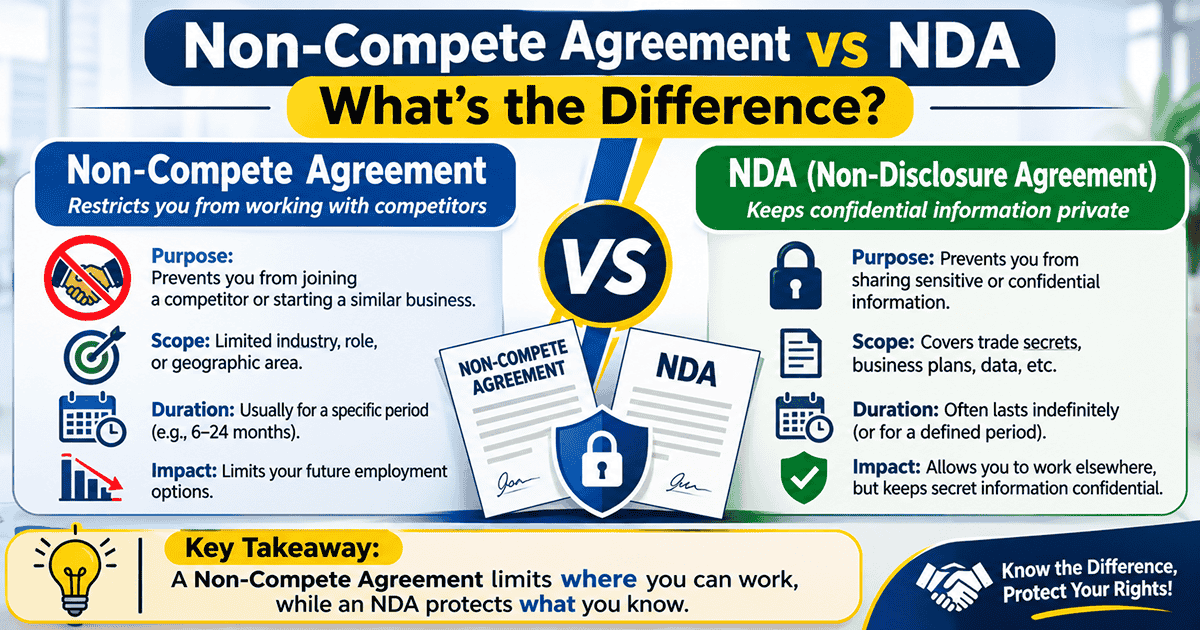
An NDA protects information. It covers trade secrets, confidential data, and business details. A non-compete protects competitive advantage. It covers your market position, client relationships, and the investment you made in someone’s training. One guards what they know, the other guards what they can do next.
2. What It Restricts
An NDA restricts sharing and using confidential information. The person can still take another job, even with a competitor, as long as they keep your secrets safe. A non-compete restricts the work itself. It can bar them from joining certain companies, serving certain clients, or starting a similar business.
3. How Long It Lasts
NDAs can run for a fixed number of years, or last as long as the information stays confidential, which is common for trade secrets. Non-competes are usually much shorter, often several months to a year or two, because courts expect a restriction on someone’s livelihood to be limited in time.
4. How Courts Treat Them
This is the biggest practical difference. NDAs are generally enforceable when they define confidential information clearly and are not overly broad. Non-competes face far more scrutiny. In the United States, enforceability depends heavily on state law. As of 2026, there is no federal ban in force, because the FTC’s 2024 rule was struck down in court and later removed from the federal regulations. Instead, each state decides. California, Minnesota, North Dakota, and Oklahoma treat most employee non-competes as void, while many other states allow them only if they are reasonable in scope, time, and geography.
5. What Happens If Someone Breaks It
Breaching an NDA can lead to damages or a court order to stop sharing the information. Breaching a non-compete can also lead to damages or an injunction, but courts are more likely to narrow or refuse to enforce a non-compete that goes too far. A badly drafted one may protect you from nothing.
When Should You Use an NDA?
Use an NDA whenever someone will see information you do not want to become public. Common situations include:
- Hiring employees who will handle internal data or client details
- Working with freelancers or agencies on product or marketing work (see our NDA for independent contractor guide)
- Talking to investors or buyers before sharing financial
- Partnering with vendors who will access your systems or plans
For most businesses, an NDA is the right place to start.
When Should You Use a Non-Compete?
A non-compete makes sense in a narrower set of cases, usually where someone holds real strategic value. That could be a senior executive, a key salesperson with deep client ties, or someone selling their business to you. Courts tend to be most comfortable with non-competes tied to the sale of a business and least comfortable with those imposed on lower-paid employees.
Before using one, check the law where your employee works. Many states now set salary thresholds, ban non-competes for certain roles, or require advance notice. Rules also differ outside the US. In India, for example, post-employment non-competes are generally not enforceable under Section 27 of the Indian Contract Act, while confidentiality obligations remain valid. Always check the rules that apply to your situation.
Do You Need Both?
Sometimes, but not always. Picture a small design agency hiring a freelancer. The owner mainly worries about client files leaking, so an NDA is enough. Now picture the agency’s top account manager, who knows every client personally. There, the owner may also want a narrow non-compete or a non-solicitation clause, so those clients are not walked out the door. In short, the NDA covers what people know, and the non-compete covers where they can take it.
Non-solicitation clauses are a useful middle option. They stop a former employee from approaching your clients or staff, without blocking them from working in their field. They tend to face less resistance in court than a full non-compete.
Both can also live inside a larger agreement. If you are drafting employment terms, our post on offer letter vs employment contract explains where these clauses usually sit.
What to Include in an NDA
A solid NDA should have:
- A clear definition of what counts as confidential information
- Exclusions, such as information that is already public
- Permitted use, so the receiving party knows what they can do with the information
- Duration of the confidentiality obligation
- Return or destruction of materials when the relationship ends
- Remedies and governing law
What to Include in a Non-Compete Agreement
A non-compete is more likely to hold up when it is specific and fair:
- Defined restricted activities, not a vague ban on “competing”
- A reasonable time limit, as short as your business can justify
- A clear geographic area or client group
- A legitimate business interest you are protecting
- Fair consideration, such as pay, a bonus, or ongoing benefits
- Governing law and dispute terms that match where the person works
Common Mistakes to Avoid
Using one when you need the other. An NDA will not stop a competitor hire, and a non-compete will not protect secrets by itself.
Making the NDA too broad. If an NDA is written so widely that it blocks someone from using their general skills, a court may treat it like a non-compete and refuse to enforce it.
Copying a template from another state. Non-compete rules vary widely. A template that works in one state can be void in another.
Setting unrealistic limits. A five-year, nationwide ban for a junior employee is likely to be struck down.
Forgetting to update. Laws on non-competes are changing quickly, so review your agreements regularly.
How to Create Both Documents Quickly
Hiring a lawyer for every agreement is expensive, especially for startups and small teams. A faster route is to generate a tailored draft and then review it for your situation.
With Indigo e-Docs, you can use the AI NDA Generator or the AI Employment Contract Generator, or create a custom document with Indigo AI in about 60 seconds. Describe your situation, and you get a structured draft you can customize. For a non-compete in particular, have a qualified lawyer review the final version, because enforceability depends so much on where you operate.
Frequently Asked Questions
Q1.What is the main difference between a non-compete agreement and an NDA?
A: An NDA stops someone from sharing or misusing your confidential information. A non-compete limits where and for whom they can work after leaving. The NDA protects what they know, while the non-compete restricts what they can do next.
Q2.Can an NDA stop an employee from working for a competitor?
A: No. An NDA only prevents the disclosure and misuse of confidential information. The person can still work for a competitor, as long as they do not reveal or use your protected information. To restrict the job itself, you would need a non-compete, where the law allows it.
Q3.Are non-compete agreements enforceable in 2026?
A: It depends on the state or country. In the US, there is no federal ban in force, so each state decides. A few states, including California, Minnesota, North Dakota, and Oklahoma, void most employee non-competes, while others enforce reasonable ones. Check the rules where the person works.
Q4.Can I put an NDA and a non-compete in the same contract?
A:Yes. Many employment contracts include both as separate clauses. Keep them clearly separated so a problem with one clause does not weaken the other, and make sure each follows the law that applies.
Q5.Do I need a non-compete if I already have an NDA?
A: Not always. If your main concern is protecting confidential information, an NDA is often enough. A non-compete or non-solicitation clause is worth considering when someone holds strong client relationships or strategic knowledge, and the law in your area allows it.
Conclusion
In the non-compete agreement vs NDA debate, the real question is what you are trying to protect. If it is information, use an NDA. If it is your client relationships or market position, consider a narrow non-compete or non-solicitation clause, and only where the law allows it. For most small businesses, a clear NDA does most of the work.
Ready to put yours in place? Generate a draft with Indigo e-Docs today.
Disclaimer: This article is for general information and is not legal advice. Non-compete and confidentiality laws vary by country and state and change often, so consult a qualified lawyer for your specific situation.